
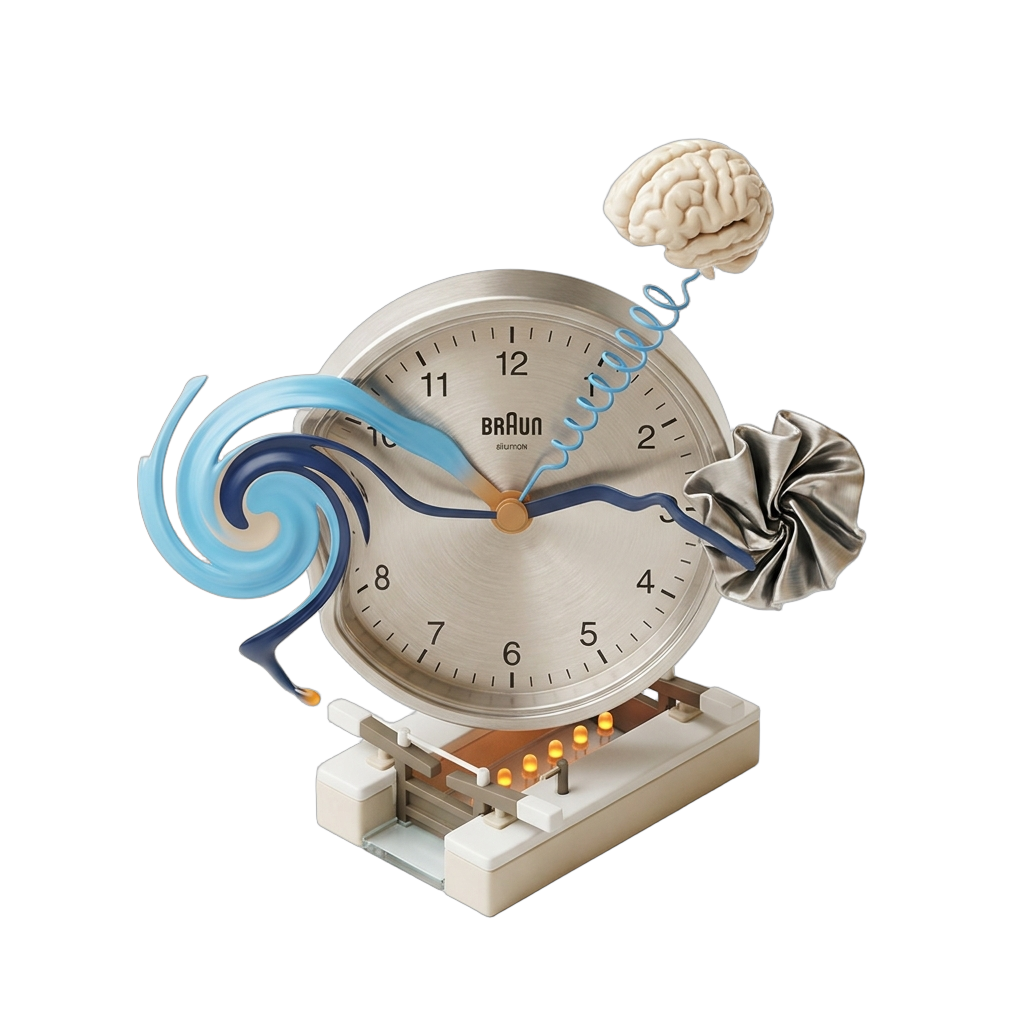
Attention Gate Model
The Attention Gate Model (AGM) is a cognitive theory of time perception proposing that subjective duration is determined by how many internal “pulses” accumulate in working memory — not by the actual passage of clock time. Developed by Zakay & Block (1995), it explains why the same objective interval feels radically different depending on mental state.
The mechanism:
- Pacemaker: An internal oscillator emitting temporal pulses at a rate proportional to arousal. Higher arousal → faster pulse emission.
- Attentional Gate: Opens in proportion to how much attention is directed toward monitoring time. Flow states close it; boredom and threat open it.
- Accumulator: Counts pulses that pass through the gate. Perceived duration scales with the count — not wall-clock time.
Time dilation effects:
- Flow state: High arousal, closed gate. Pulses barely accumulate. An hour feels like ten minutes.
- Threat / near-accidents: Arousal spikes and the gate opens simultaneously — double amplification. The “slow motion” effect during danger.
- Boredom: Low arousal, gate wide open. Duration inflates without intensity.
- Novelty: New environments force temporal monitoring (gate stays open), making first experiences feel longer — both in the moment and in memory.
The AGM’s subjective dilation is structurally identical to relativistic time dilation: the same interval produces different duration readings depending on the state of the observer doing the measuring.
→ Try the interactive AGM simulator — manipulate arousal and attention in real time to warp the clocks yourself.
perceptionneurosciencetimecognitionpsychology