
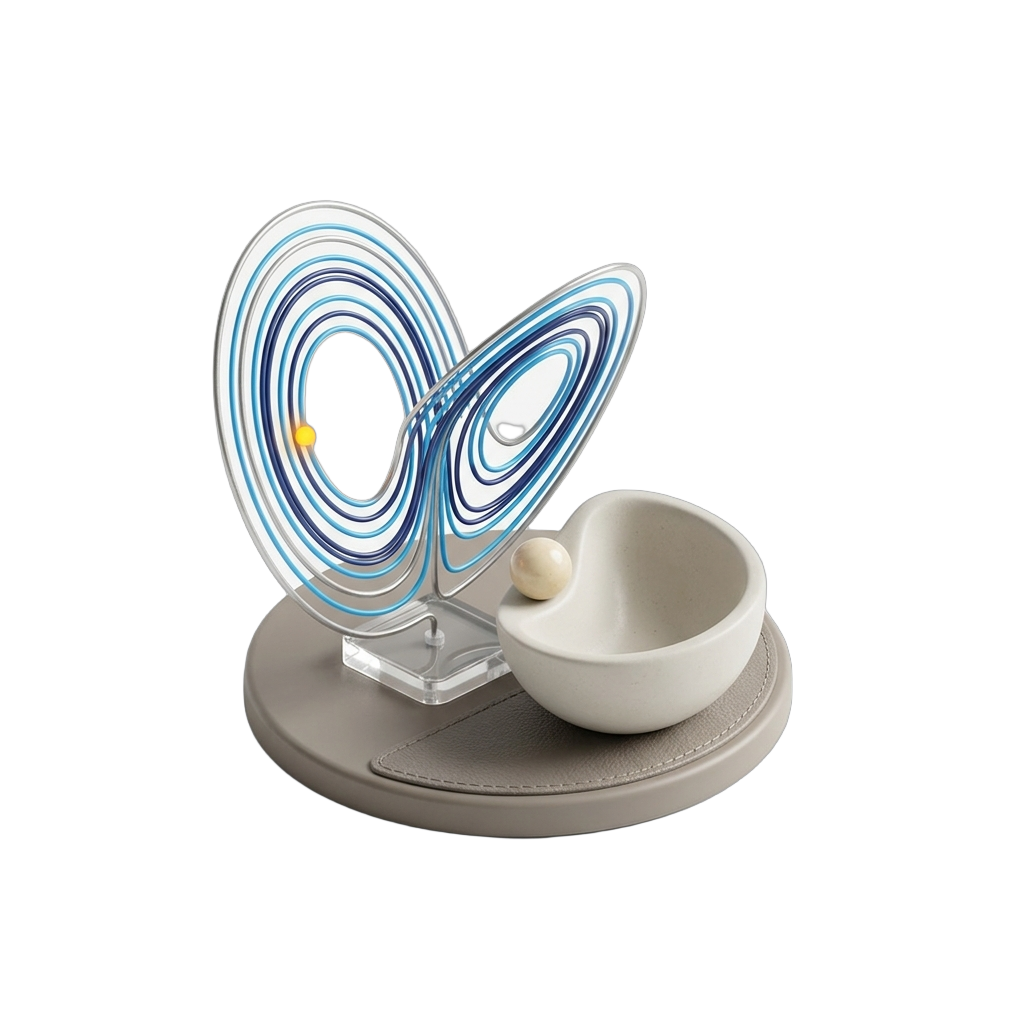
Attractor
In the mathematical field of dynamical systems, an attractor is a set of states toward which a system tends to evolve, for a wide variety of starting conditions. System values that get close enough to the attractor values remain close even if slightly disturbed — the system is pulled back rather than pushed away.
Types of attractors:
- Fixed point attractor: The system converges to a single stable state. A pendulum with friction eventually comes to rest at one point.
- Limit cycle: The system settles into a repeating periodic orbit. A heartbeat’s electrical rhythm approximates this — disturbed, it returns to its cycle.
- Strange attractor: Found in chaotic systems, these have fractal structure. The Lorenz attractor is the canonical example — a system that never repeats yet stays bounded within a characteristic butterfly shape. Sensitive to initial conditions, but not random.
Why it matters beyond math:
Attractor thinking is useful anywhere a system has preferred states it returns to after perturbation. Behavioral patterns, organizational cultures, and neural resting states all exhibit attractor-like dynamics. The concept reframes stability not as rigidity but as a basin of attraction — a region of state space that the system falls into and stays near.
The key insight is that attractors reveal the deep structure of a system’s long-run behavior, independent of where it started.