
Fusiform Face Area
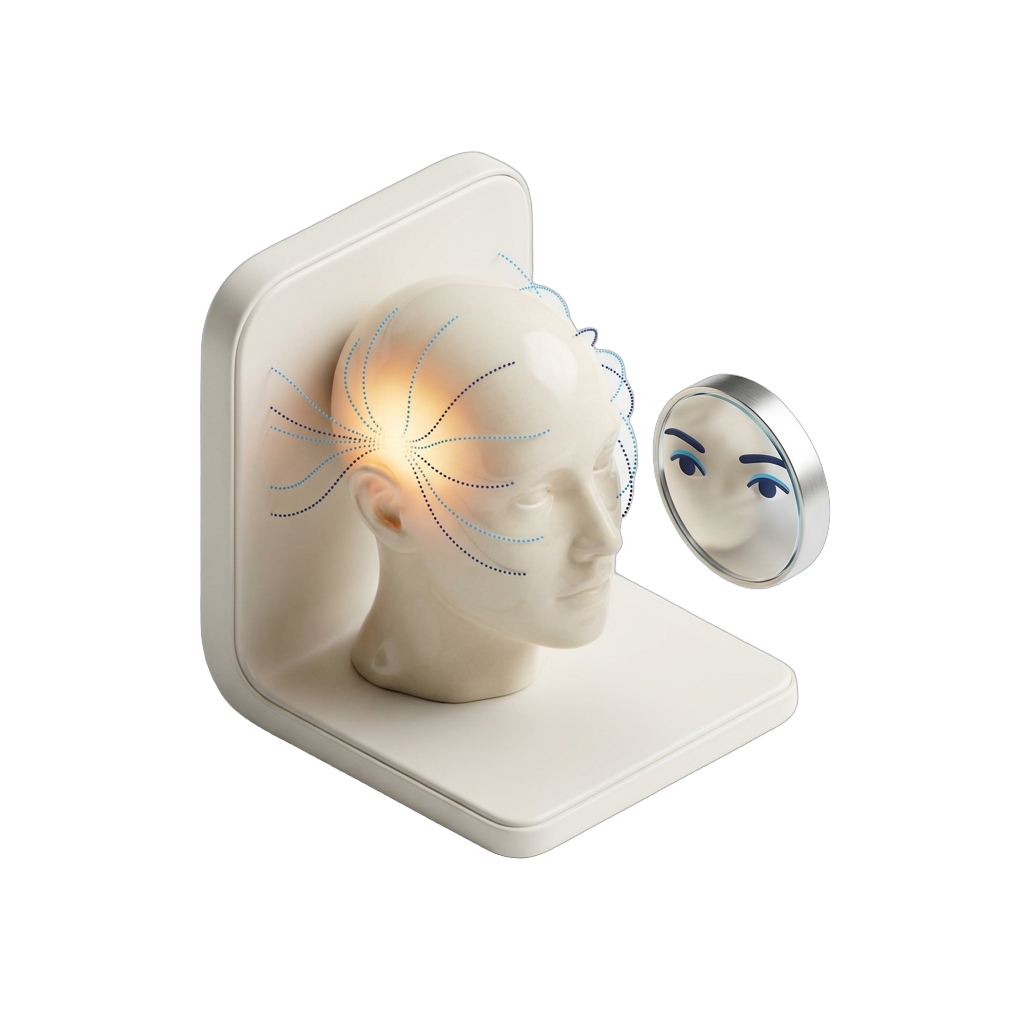
Deep inside your brain sits a tiny region called the Fusiform Face Area (FFA) — and its entire job is recognising faces. Located in the temporal lobe (roughly behind your right ear), this small patch of cortex lights up with activity the moment you look at a human face, far more than it does for any other object.
First identified by neuroscientist Nancy Kanwisher in 1997, the FFA works as part of a broader network that helps you do everything from spotting a friend across a crowded room to reading the subtle difference between a smile and a smirk.
The FFA fires selectively in response to faces, not objects, places, or words — the brain allocates dedicated hardware. It works downstream with the superior temporal sulcus and amygdala to map who a face belongs to and what it’s expressing. Critically, it processes a face as a whole gestalt rather than as a sum of parts — which is why inverted or scrambled faces are disproportionately hard to read. This configural output feeds into the broader network responsible for inferring mental states from facial cues: theory of mind in action.
When this region is damaged, people can develop a condition called prosopagnosia — the inability to recognise faces, even those of close family members. Sufferers must resort to voice, gait, or hairstyle to identify people they’ve known for years. The selectivity of the impairment — everything else intact, faces gone — is one of the cleaner demonstrations in all of neuroscience that the brain really does carve cognition into highly specialised modules.
There is ongoing debate about whether the FFA is truly “face-only” or more broadly tuned to the recognition of any object category with which we have deep visual expertise (some bird experts show FFA activation for birds; chess masters for board positions). But faces remain the strongest, most universal activator by far — we are, after all, an intensely social species who has been reading each other’s faces for millions of years.
Personal note
I find myself thinking about the FFA in reverse. When I’m around someone I’m genuinely captivated by, I’ll sometimes deliberately avoid looking at their face — a small, conscious act of dampening the signal before it overwhelms the system. Not avoidance exactly; more like turning down the gain. The FFA doesn’t come with a volume knob, but apparently the rest of me tries to build one.
It’s a strange thing to catch yourself doing: engineering a micro-interruption in a circuit that evolution spent a very long time making automatic. Whether it works is another question.